·
·
AI / Artificial Intelligence
Anthropic/Claude
OpenAI/ChatGPT
Mistral AI
Google / Gemini
·
LLM
Anthropic/Claude
OpenAI/ChatGPT
Mistral AI
Google/Gemini
European AI
AI News Week 19 – Claude in Photoshop, GPT-5.5 catches up, Apertus 1.5 is just around the corner
Anthropic is integrating Claude into nine creative apps. OpenAI is launching GPT-5.5 and catching up with Claude in agentic work. Gemini can now create Word, Excel, PDF and slide files directly in chat. Mistral has released a 128B model under the MIT licence. And Apertus 1.5 8B arrives this May – a serious option for sensitive Swiss data.
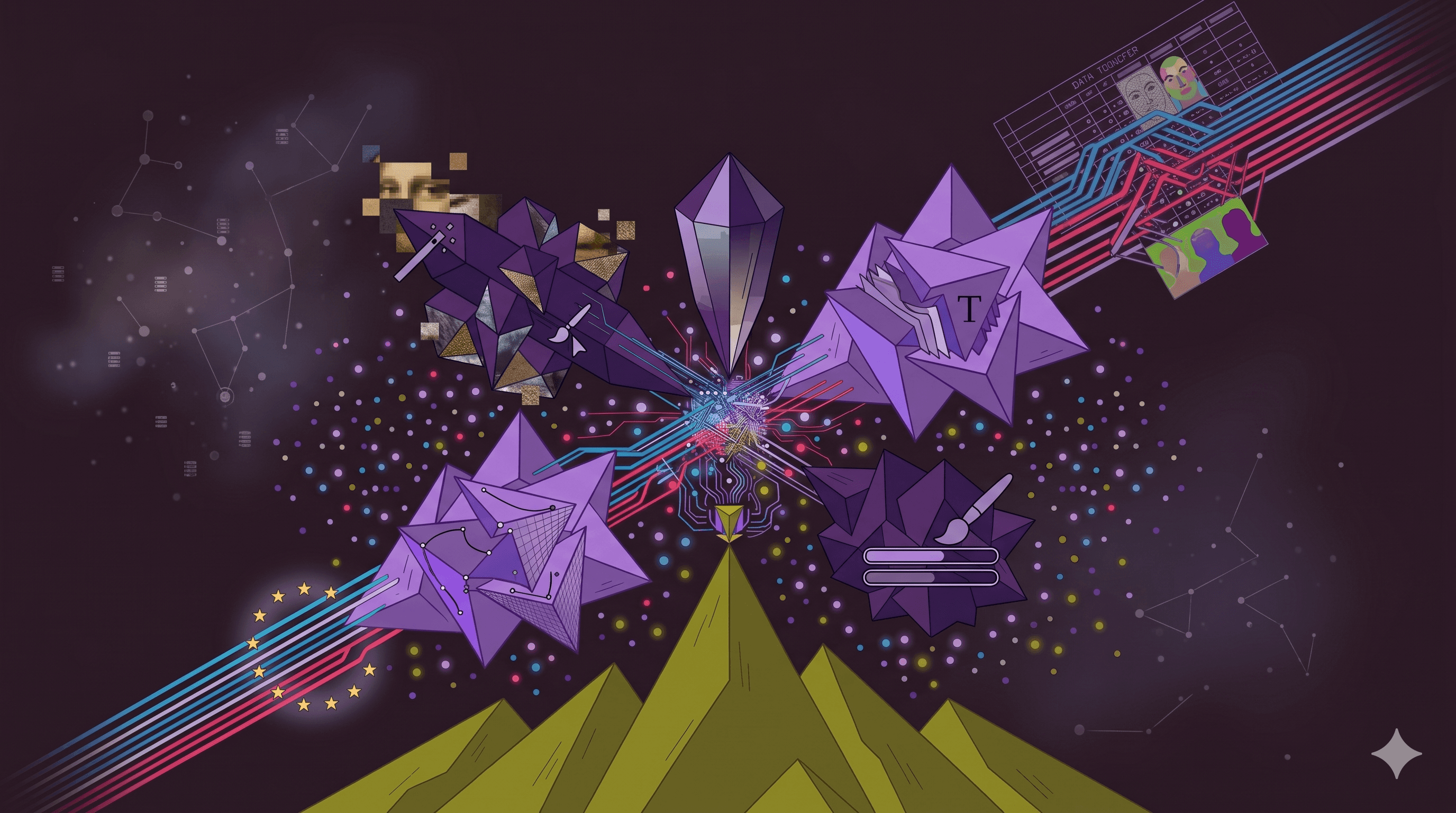
1. Anthropic connects Claude with Adobe, Blender, Autodesk and six other creative tools
On 28 April 2026, Anthropic launched «Claude for Creative Work». Nine new connectors link Claude directly to Adobe Creative Cloud, Blender, Autodesk Fusion, Ableton, SketchUp, Affinity by Canva, Splice, as well as Resolume Arena and Wire. This positions Claude as the orchestration layer for design, 3D, music and live-visual pipelines.
The Adobe connector accesses more than 50 tools from Creative Cloud, including Photoshop, Premiere and Express. The Fusion connector generates 3D models from natural-language descriptions. The Blender connector is based on MCP, so it is also open to other LLMs. Anthropic is also working with the Rhode Island School of Design, Ringling College and Goldsmiths London on student access.
To understand this move, look at Claude Opus 4.7 (16 April) and Claude Design (17 April), released two weeks earlier. Anthropic is turning Claude from a chat assistant into a tool hub.
Recommendation: If you work in marketing or design with Adobe, test the connector. Today, the realistic gain is faster repetitive work, not replacement of design work.
Sources: Anthropic: Claude for Creative Work | 9to5Mac | Neowin
2. OpenAI releases GPT-5.5 – and catches up in agentic work
OpenAI launched GPT-5.5 on 23 April 2026. The model plans multi-step tasks, uses tools, checks its own outputs and works through ambiguity. About time. Anthropic has shown this with Claude since mid-2024. We will see how much ChatGPT has really caught up in practice. The API has been available since 24 April, with a 1 million token context window (400K in Codex).
The published benchmarks (all from OpenAI):
84.9 % on GDPval (knowledge work across 44 professions)
78.7 % on OSWorld-Verified (computer operation)
98.0 % on Tau2-bench Telecom (customer service workflows without prompt tuning)
82.7 % on Terminal-Bench 2.0 (Claude Opus 4.7: 69.4 %, Gemini 3.1 Pro: 68.5 %)
Benchmarks are lab tests. They say little about reality. They also measure the bare model via the API. In ChatGPT, something else arrives: system prompts, safety filters and the UI layer change the behaviour. ChatGPT is a consumer product, not a business platform. In recent months, OpenAI has repeatedly downgraded models in ChatGPT or overwritten them with default prompts, without saying so clearly. If you want to work with the real model performance, use the API or Codex — not the ChatGPT UI.
Caveat: Vendor benchmarks from OpenAI itself. The point is not the table, but how reliably the agent completes a real task without intervention — and how much of that actually makes it into the final ChatGPT product.
Sources: OpenAI: Introducing GPT-5.5 | TechCrunch | Decrypt
3. Google: Gemini now creates Word, Excel, PDF and Slides directly in chat
This is new: Gemini generates files on request — Word documents, Excel sheets, PDFs, Google Docs, Sheets and Slides. If you need a memo, a table or a slide deck draft, you get it straight from the chat as a download. The feature has rolled out globally, applies to all Gemini app users and closes a gap where ChatGPT with Canvas and Claude with artefacts had been ahead.
Still included in the April drop: native macOS app, personalised image generation, NotebookLM project organisation, Lyria 3 Pro music tracks up to 3 minutes free.
The problem is not the model. Google is innovative in some areas. But its roll-out is chronically slow. Example: project folders in Gemini are still not available in Switzerland — not even for paying business users. Anyone reading about Gemini features should first check whether they actually work here. If Google keeps this up, it will fall further behind Anthropic and OpenAI — not technically, but in distribution.
At the same time, Google launched Deep Research and Deep Research Max in the Gemini API on 21 April. Both run on Gemini 3.1 Pro; Max uses more compute for long asynchronous research. Target group: enterprise analysts.
Recommendation: Test file generation in the workflow as soon as it is available for your account in Switzerland. For Gemini features, always check in advance whether they work here too.
Sources: Google: Files in Gemini | Gemini Drop April 2026 | Deep Research Max
4. Mistral releases Medium 3.5 – catches up, small models remain more interesting
On 29 April 2026, Mistral AI published Mistral Medium 3.5: a dense 128B model with a 256K context window, modified MIT licence, downloadable on Hugging Face. Score on SWE-Bench Verified: 77.6 %. The model closes the gap to Claude and GPT-5.5 clearly — even if the context window still trails at 1 million tokens from OpenAI and 200K from Claude.
Mistral’s real core strength is not the benchmark, but geography: the data centre is in France. No US Cloud Act, no Patriot Act, no mandatory data disclosure to US authorities. For Swiss companies with EU data-protection requirements, Mistral is often the only cloud option that avoids the third-country transfer question.
But Mistral’s smaller models are more interesting than the 128B flagship. They can run on-premise — on your own GPUs, in your own data centre, without data leaving the building. A 128B model needs its own data centre to run in production; a 7B or 24B model runs on four workstation cards. That is where open source becomes usable.
At the same time, Mistral launched «Vibe Remote Agents»: coding sessions in the cloud, startable from CLI or Le Chat, with integration into GitHub, Linear, Jira, Sentry, Slack and Teams. On 28 April, Workflows followed as a public preview — orchestration with human-in-the-loop and on-prem deployment.
Recommendation: For sensitive data in Switzerland or the EU, check Mistral as a cloud option if US vendors are legally problematic. For full control, test the smaller models on-premise — that is open-source logic in practice.
Sources: Mistral: Vibe Remote Agents + Medium 3.5 | MarkTechPost | The Decoder: Workflows
5. Switzerland & Europe: Apertus 1.5 closes in on Gemma, EU deadlines remain open
Apertus, the open language model from ETH, EPFL and CSCS, will get a 1.5 version of the 8B variant this May. The leap matters: Apertus 1.0 was already competitive with Meta’s Llama. Apertus 1.5 now closes in on Google’s Gemma models. That puts Switzerland, for the first time, on equal footing with the US tech giants in open 8B models. That is something to be proud of.
This matters in practice for any Swiss company handling sensitive data that does not want to send it to a US cloud: Apertus runs self-hosted or via Swisscom as a Swiss provider, stays under Swiss law and is fully documented as open. In concrete terms: internal applications with personal data, contracts, patient data or government communications can be built on Apertus without the data leaving the building. The canton of Ticino has been doing this for administrative translations since March.
In Brussels, the EU AI Act deadline remains unclear. Strict rules for high-risk systems were supposed to apply from 2 August 2026. The European Commission wants to push this back by 16 months, but the trilogue ended on 28 April without agreement. For Swiss firms with EU business, that means: keep working towards 2 August 2026. Anyone using AI systems in the EU market should now create an inventory, classify the risk level of each system, and close gaps in documentation and risk management.
Swiss law itself will remain sectoral — so no single comprehensive AI regulation, but amendments to individual laws. The federal proposal is expected by the end of 2026.
From the US: On 24 April, Anthropic published election safety measures for the 2026 midterms. In Anthropic’s tests, Opus 4.7 reached 95 % and Sonnet 4.6 reached 96 % on political neutrality.
Recommendation: Put Apertus 1.5 8B on your radar as soon as it is released. For internal use cases with sensitive data, an open model hosted in Switzerland is often the only clean option.
Sources: Apertus / EPFL | Apertus / Ticino | EU trilogue: DLA Piper | Anthropic: Election Safeguards
Three recommendations for the week
Connector instead of copy and paste: If you have Adobe or Blender in your stack, test the Claude connector in a pilot. Question: which two or three repetitive steps does it save per project?
Test agentic models with a clear head: GPT-5.5 and Mistral Medium 3.5 promise autonomous multi-step tasks. Rather than trusting benchmarks, run a real workflow — and measure how often intervention is needed.
Check Apertus 1.5 for sensitive data: Once the new 8B model is out, test it with a concrete internal use case. Contracts, HR data, government communications — applications where the data must not leave the country.