The 6 Phases of AI Excellence
Thanks to the immense progress in machine-learning algorithms and server performance, combined with the wide availability of training data on the internet, artificial intelligence has made a huge leap forward.
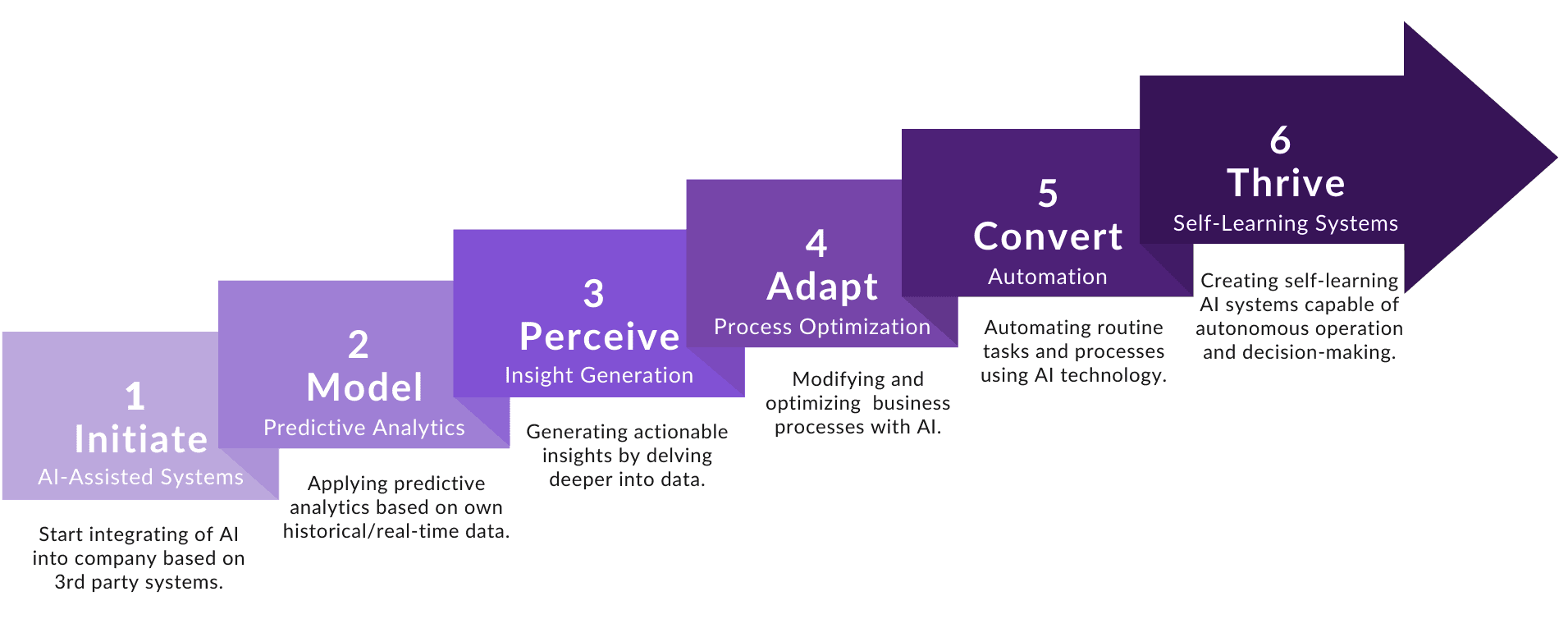
Six phases to a comprehensive AI strategy
Thanks to the huge progress in machine learning algorithms and server power, together with the wide availability of training data on the internet, artificial intelligence has made a huge leap.
But it was the simple, intuitive access offered by ChatGPT, Bard or MidJourney that put the topic at the centre of society. Many companies already use these tools every day, sometimes without knowing it, introduced by their own staff. We offer corporate training so everyone becomes a “prompt expert” and use is more targeted and efficient.
But if all companies use the same tools, they become interchangeable. To secure a strategic competitive advantage over the long term, companies must use their own data and develop their own algorithms and systems.
I have identified six phases of AI use that can have a major impact on a company and can be developed step by step. In short, they generate IMPACT:
1. Initiate
In this phase, the aim is to explore AI-powered tools and platforms and start first projects. For example, a marketing team can build the social media content calendar with ChatGPT or optimise targeting and ad delivery on Meta using an algorithm.
Typical tools in this phase include ChatGPT, MidJourney, Canva, etc. Simple AI chatbots are also typical uses here.
Requirement: Basic understanding of AI technology, AI corporate guidelines, structured text data.
Complexity: Relatively low
Benefit: Higher productivity and an early view of AI’s potential.
Even at this stage, basic AI guidelines should be in place for all employees.
2. Model
In this phase, AI is used to create forecasts and predictions for trends and behavioural patterns based on existing historical data. Example: a finance team uses no-code tools to model future sales trends based on historic sales data. This enables more precise, better informed planning.
Tools: This often uses data science and machine learning tools that let users build predictive models. Examples include RapidMiner, Dataiku or KNIME, which can be used without programming (no-code tools). Applications such as numerous.ai or Google’s Small ML should also be mentioned.
Requirement: Availability and access to high-quality data.
Cost: Low to medium
Benefit: Better business insight and forecasting accuracy.
3. Perceive
This phase involves using AI to interpret data and gain deep, nuanced insights. The focus is on discovering patterns and relationships that provide a full understanding of the underlying processes. Real-time data can also be used here. Example: an operations team uses AI tools to analyse production data and uncover hidden inefficiencies or bottlenecks. This makes targeted improvement measures possible.
Tools: Insights from the Model phase can be used here with more advanced tools such as Python or R, with specialist libraries like Pandas, TensorFlow or PyTorch. They offer more flexibility, control and scalability.
Requirement: Data analysis and interpretation skills.
Cost: Medium to high
Benefit: Deeper insights and better decision-making.
4. Adapt
Here, AI is used to modify and optimise existing business processes. Example: a manufacturing company uses AI to optimise its supply chain and reduce waste and delays.
Tools: Advanced tools can be used here. They use machine learning and optimisation algorithms to improve processes and systems. This can also build on the previous phase. A good example is the ML framework Scikit-Learn, implemented in Python.
Requirement: Deep understanding of business processes and the ability to integrate AI
Cost: High
Benefit: Improved efficiency and lower costs.
5. Convert
This phase is about automating routine tasks and processes with the help of AI. Example: an HR team uses AI to automate applicant screening, improving time efficiency and freeing up people for more strategic tasks.
Tools: Robotic Process Automation (RPA) tools such as UiPath or Automation Anywhere can be used here, as can sector-specific solutions such as Workfusion or AI-driven automation platforms such as Databricks Autopilot.
Requirement: Clearly defined and standardised processes
Cost: High
Benefit: Time savings and improved accuracy.
6. Thrive
The final phase involves developing self-learning AI systems that can act autonomously and make decisions. Example: Tesla with its self-driving cars, which constantly learn and adapt to new driving situations.
Tools: This requires specialist tools and platforms that offer advanced AI and machine learning functions. Examples include TensorFlow or PyTorch, as well as cloud-based AI platforms such as Google AutoML or Amazon SageMaker.
Requirement: Advanced AI capability and a solid data infrastructure
Cost: Very high
Benefit: Autonomous and continuous improvement.
Step by step to the right AI strategy
The path to full use of AI is not a sprint, but a marathon. Each phase offers its own benefits and challenges, and a step-by-step approach can ensure that your company unlocks the full potential of AI. It is important to build a solid base at each stage before moving to the next. And across all phases, one thing is certain: the better the data, the better the results with AI.
If done properly, AI can have an enormous IMPACT on your company.
Shall we help you develop an AI strategy?